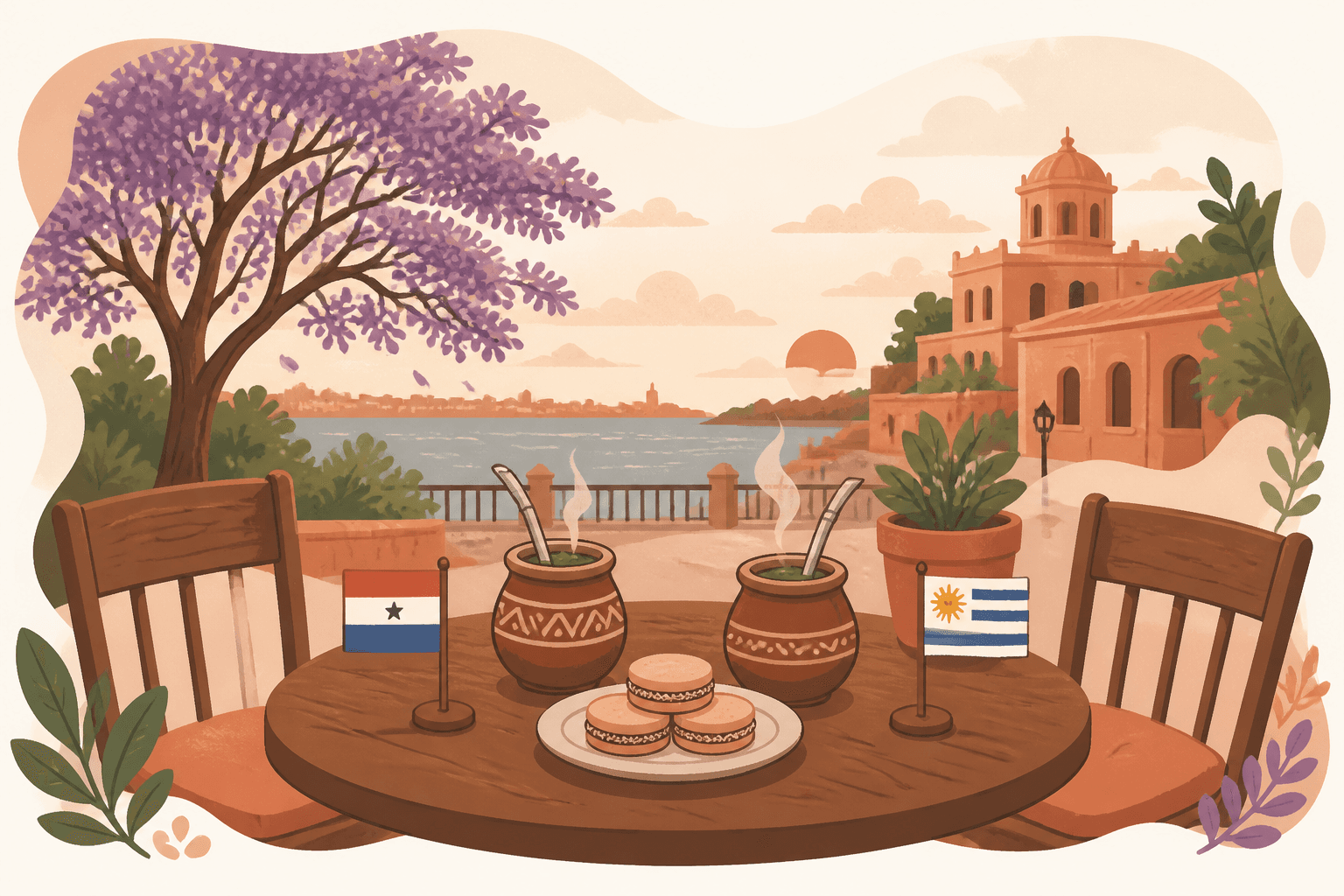
Paraguay y Uruguay: mate, farra y rivalidades
Hola, amigos. Pull up a chair — this week's sobremesa is a trip across two countries that look small on the map and enormous once you start talking.
Before they even hit record, Will asked Daniela about jopará: a mix of Guaraní and Spanish, and also the name of a stew that's… well, a mix. That's the whole episode in one word. Paraguay and Uruguay sit between giants, and the language, the jokes, and the food all carry that mixing.
If you want the 19th-century history of why these two countries exist at all, we already wrote that: Algodón entre cristales. This episode is different. It's Daniela, from the Argentine side of the border, talking about the people she actually knows.
Cómo se dicen Paraguay y Uruguay
English puts a "way" at the end. Spanish — and Guaraní — treat that y more like a vowel. Daniela walks Will through it: Paraguay, Uruguay, closer to para-guai, uru-guai. Once you hear it, you can't unhear the English version.
Paraguay has two official languages: español and guaraní. That's not a textbook footnote. Daniela has been across the border from Buenos Aires many times. Asunción only once. The rest of Paraguay, several times. She feels closer to Paraguay than to Uruguay — the language, the ways, the people.
La gente, la farra, y una amistad que no es áspera
Daniela's take, with the caveat she puts on it herself: if a Paraguayan is listening and she's wrong, perdón.
The Paraguayans she knows are graciosos, close, and the best people to go out with. The word she wants in your notes is farra — going out, the party, the night that becomes a story. Meet someone once and you're family. They take care of you.
Argentines, she says, are more distant. Not exactly frío. The word she reaches for is áspero — rough, the opposite of soft — for how the relationship can feel, compared with that Paraguayan closeness.
She also says Paraguayan culture, in general terms, is a bit more conservative, with clearer gender roles. Not everyone. Not a rule. Her read.
Then Uruguay. Argentine humor still calls it a provincia — a neighborhood that wandered off and became a country. Daniela knows the joke is tired, and that Uruguay is independent, with its own beaches, its own dollars, and, yes, a lot of ganado. Mate and dulce de leche remain open arguments. Uruguayans will tell you their mate process is better. Argentines will tell you otherwise. This is not getting settled in one episode.
¿Paraguay o Uruguay?
If you're going: Daniela would start in Asunción if you don't know Paraguay yet. She recommends Paraguay first — closer, warmer, cheaper for an Argentine. Uruguay is the international beach trip: more tourist infrastructure, more expensive, often priced in dollars.
She wants to know Uruguay better. She already knows which door she'd open first.
El vocabulario de la sobremesa
jopará — the mix of Guaraní and Spanish (and a mixed stew that lives up to the name)
guaraní — Paraguay's co-official language, still spoken every day
farra — going out; the party; the night
gracioso/a — funny in a way that actually makes you laugh
áspero — rough (texture, and by extension a relationship that isn't soft)
provincia — the teasing Argentine word for Uruguay (don't use it on a Uruguayan unless you know them)
ganado — livestock; the cattle that still shape Uruguay's economy
mate — you know this one. The fight is over how you make it
dulce de leche — the other fight. Paraguay, Uruguay, and Argentina all have a side
reflexiones — insights, reflections (the word Will asked Daniela for)
Watch the full episode
This is what we do at Spanish Minds: we don't teach Spanish from a map. We teach it from a table, a mate, and the arguments that only happen between neighbors.
Watch the full episode on YouTube
Your turn. ¿De qué lado estás en el debate del mate? And which country are you more curious about — Paraguay or Uruguay? Tell us in the comments — leemos todos.
Learn Spanish through real stories
Read 2 legends free, plus free access to our Flashcards site. No payment required to start.