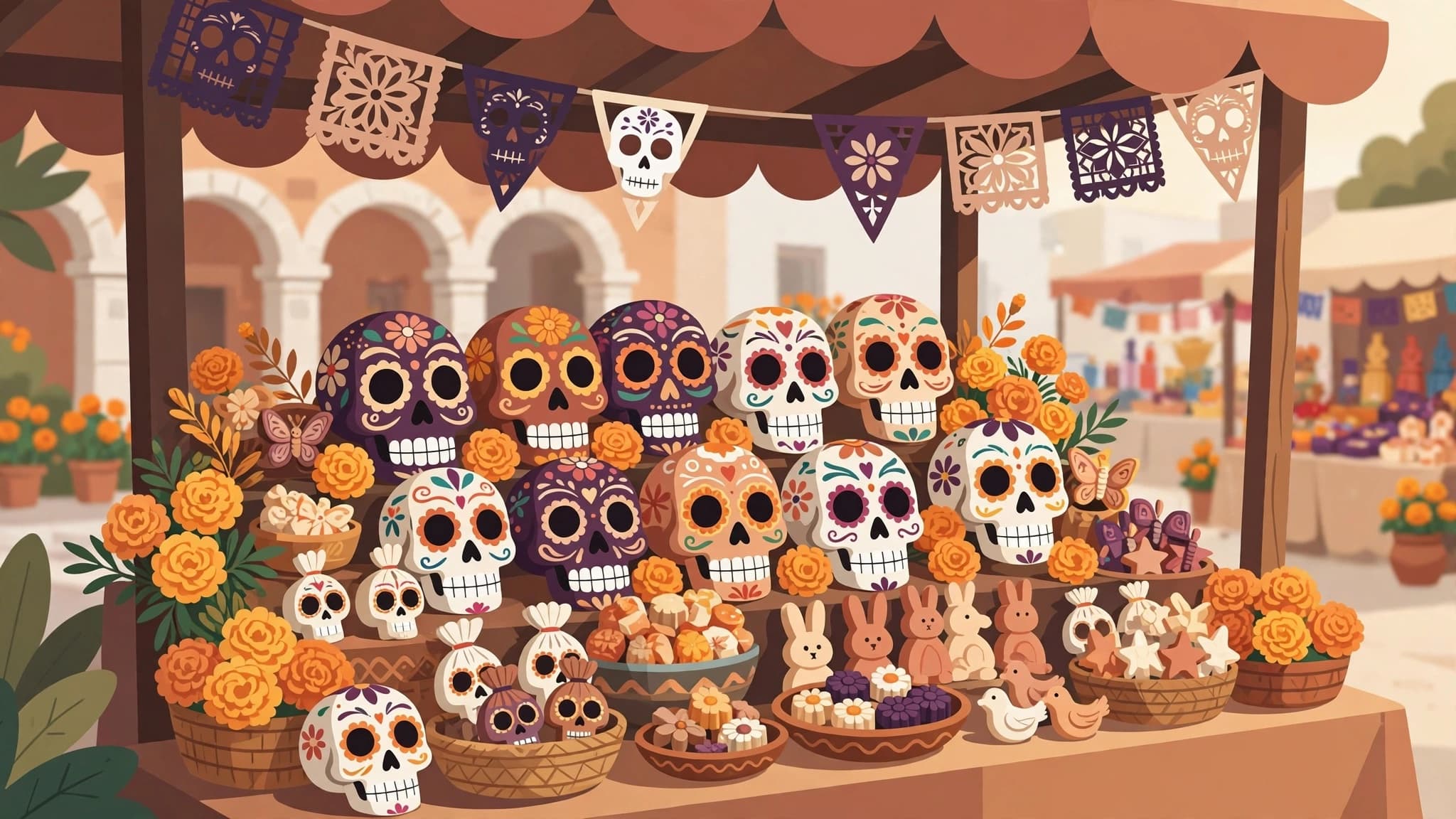
Why sugar skulls have names: inside Toluca's Alfeñique Fair
Walk through Los Portales in central Toluca in October and the first thing you notice is color. White skulls wear electric-blue eyes, pink icing curls, foil foreheads, flowers, crowns, and tiny smiles. Look closer and you may find a name written across one of them.
That name is the key to understanding the calaverita de azúcar, or sugar skull. It turns a general symbol of death into something personal.
A skull can be for the dead—or the living
During Día de Muertos, families prepare an ofrenda, an altar that welcomes and remembers people who have died. A sugar skull bearing a loved one's name can be placed on the altar as an offering. The name says: this one is for you. You are still part of the family story.
But a skull with your own name is not necessarily a threat. Calaveritas are also exchanged among living friends and relatives. In that context, the gift can be teasing and affectionate: a reminder that mortality belongs to everyone, and that thinking about death does not have to erase sweetness, humor, or love.
This is one of the most striking ideas behind Día de Muertos. Death appears, but it does not get the final word. The skull is made of sugar. The skeleton dances. Memory becomes something the living make together.
Why Toluca is the place to see alfeñique
Toluca, the capital of the State of Mexico, is famous for alfeñique: a moldable sugar paste used to create skulls, coffins, animals, fruit, and other figures for Día de Muertos. The technique has roots in sugar work brought to Mexico through Spain, while its Mexican meaning developed within local ways of honoring the dead.
Families of artisans spend months making and decorating the pieces. The work is not simply seasonal manufacturing. It is knowledge passed from grandparents to parents and children: how to prepare the paste, judge the humidity, release a figure from its mold, attach fragile details, and pipe icing without crushing the form.
In 2026, Toluca's Feria y Festival Cultural del Alfeñique runs from early October into the Día de Muertos period, with the traditional sale in Los Portales reported for October 3 through November 2. The program extends beyond sweets to music, theater, workshops, exhibitions, night tours, and other public events. The fair itself has been associated with Los Portales since 1932, while the craft is far older.
A tiny lesson in how Mexican Spanish plays with death
The fair also opens a door onto the language of the season. In Mexican Spanish, the diminutive -ita can express smallness, familiarity, or affection. A calavera is a skull; a calaverita is literally a little skull, but the word sounds warmer and more playful than the English translation suggests.
A calaverita literaria is something else: a short, humorous poem in which Death comes for a living person, usually after a joke about that person's habits or personality. Like the sugar skull with a living friend's name, the poem brings death close enough to laugh at it.
Spanish to take with you
el alfeñique — molded sugar paste; also a figure made from it
la calaverita de azúcar — sugar skull
la ofrenda — offering; also the Día de Muertos altar in common usage
recordar a alguien — to remember someone
honrar la memoria de alguien — to honor someone's memory
el artesano / la artesana — artisan
hecho a mano — handmade
poner el nombre en la frente — to put the name on the forehead
Try this sentence: Esta calaverita lleva el nombre de mi abuela y la vamos a poner en la ofrenda. This sugar skull bears my grandmother's name, and we are going to place it on the altar.
More than a souvenir
It is easy to photograph the brightest skull, buy one, and move on. Yet the name asks you to slow down. Whose name is it? Is the skull remembering someone, celebrating someone, or gently teasing someone about the fate we all share?
At its best, the Alfeñique Fair does not make death feel trivial. It makes remembrance visible. Sugar, paper, icing, and a handwritten name become a small declaration: a person was here, remains loved, and still has a place at the table.
Sources and further reading
Learn Spanish through real stories
Read 2 legends free, plus free access to our Flashcards site. No payment required to start.