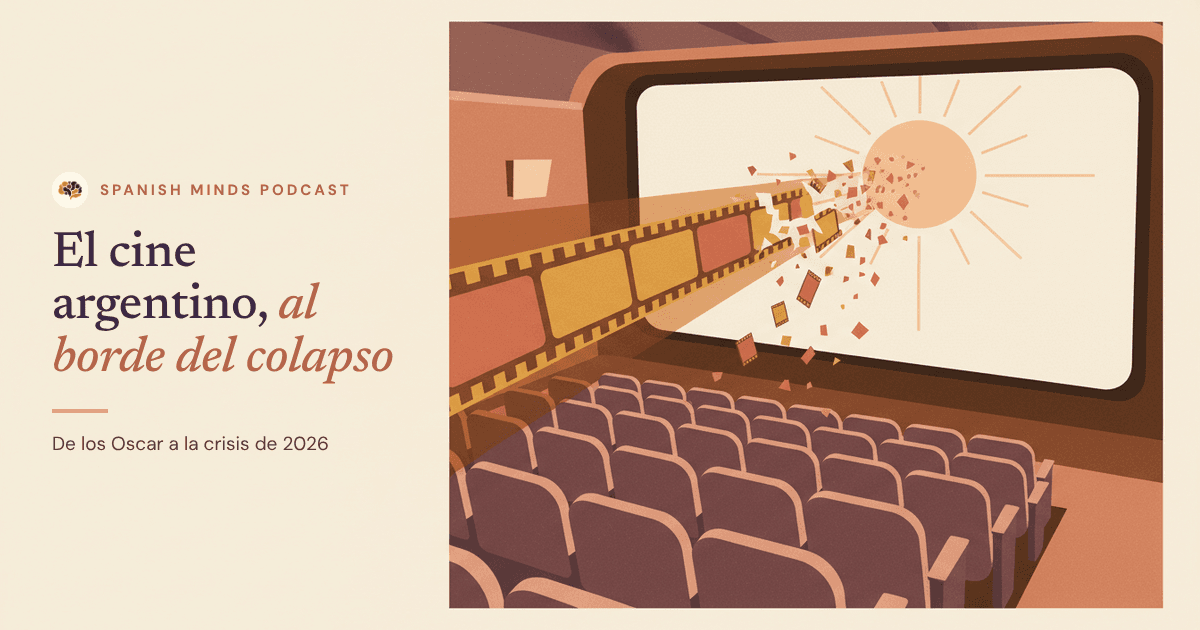
l cine argentino, al borde del colapso: de los Oscar a la crisis de 2026
Here's a puzzle. A country at the bottom of the map holds Latin America's record for Oscars in the international category, keeps winning Spain's Goya awards, and sends its directors straight into Hollywood's biggest productions. And yet, in 2026, people who make films there are asking a hard question: ¿puede sobrevivir el cine argentino? Can Argentine cinema survive?
That's the question at the heart of our new podcast episode, "El cine argentino, al borde del colapso." Here are the highlights, with the Spanish you'll want to know along the way.
🎧 Escuchá el episodio completo: [Listen on the Spanish Minds Podcast]([Buzzsprout episode link]). It's fully in Spanish, for advanced learners (B2–C1).
Palabras clave / Key words
la taquilla: the box office
el celuloide / la película virgen: film stock (unexposed film)
el plano secuencia: a long take, filmed in one continuous shot
el fomento: public funding and support for an industry
la fuga de cerebros: brain drain
al borde del colapso: on the brink of collapse
el pochoclo: popcorn, the Argentine way
## Un récord que no es casualidad / A record that's no accident
Argentina has won the Oscar for Best International Feature twice: La historia oficial (1985) and El secreto de sus ojos (2009). It has eight nominations in the category in total, including Relatos salvajes and Argentina, 1985. In Spain, Argentine films had won 19 Goya awards for Best Ibero-American Film by 2023, more than any other country. Dolores Fonzi's Belén brought the total to 20 in February 2026.
The episode argues that the secret is a rare mix: cine de autor (arthouse cinema) combined with cine de género (genre film: thrillers, black comedy, horror). Think of a chef who blends fine dining with street food. You get something smart and hugely popular.
Two classic examples:
***Relatos salvajes*** (Damián Szifrón): an anthology of short, tense stories that work like a thriller and also take a hard look at frustration and inequality.
***Nueve reinas*** (Fabián Bielinsky): a con-artist film with a script so tight that Hollywood remade it as Criminal (2004).
A lot of that craft comes from serious training at schools like the ENERC (the national public film school) and the Universidad del Cine (FUC). Students learn the classic rules of storytelling so well that they know exactly how to bend them.
De un corto de terror a Hollywood / From a horror short to Hollywood
Andy Muschietti's story is the perfect example. His short horror film ***Mamá*** caught the attention of Guillermo del Toro, who produced its feature version, Mama (2013). Muschietti went on to direct It and The Flash.
How do directors like him keep their identity inside the Hollywood machine? According to the critics cited in the episode, it's the characters. They deliver the spectacle the studios want, but they add textura psicológica (psychological texture): family ties, trauma, emotional weight.
La época de oro / The golden age (1933–1956)
None of this came out of nowhere. In the 1930s, Argentina built a real studio system modeled on Hollywood, with companies like Lumiton and Argentina Sono Film. The films ran on tango, melodrama, and stars of the working class like Carlos Gardel and Libertad Lamarque.
It worked. By the end of the 1930s, Argentina was the leading producer of Spanish-language films in the world.
## 1943: el boicot del celuloide / The film-stock boycott
Then geopolitics stepped in. Argentina stayed neutral during most of World War II, and the United States answered by restricting its sales of película virgen (raw film stock) to the country. Sin celuloide, no hay películas: no film stock, no films. At the same time, the US backed Mexico's film industry. Mexico took over the leadership of Spanish-language cinema, and Argentina's classic studio system never fully recovered.
## El Nuevo Cine Argentino / The new wave of the 90s
The collapse of the big-studio model eventually made room for something completely different. In the 1990s and 2000s, directors like Lucrecia Martel, Adrián Caetano, Bruno Stagnaro, and Daniel Burman rejected heroes and melodrama. They filmed on the street, cast non-professional actors, and used the plano secuencia (long take), which drops you into the action in real time with no edits to hide behind.
Martel's ***La ciénaga*** (2001) is the key film of this period. In 2022, a poll of more than 500 people from Argentine film culture voted it the best Argentine film of all time.
Today's directors combine both traditions: the emotional pull and classic structure of the golden age, plus the raw realism of the 90s. Esqueleto comercial, músculos de autor: a commercial skeleton with arthouse muscle.
## Cine y memoria / Cinema and memory
That realism isn't only a style. It's tied to Argentina's history. During the military dictatorship (1976–1983), censorship was severe, and many filmmakers went into exile. With the return to democracy, cinema became a way to look back and process the past: La historia oficial, La noche de los lápices, and more recently Argentina, 1985, which won the Golden Globe for Best Non-English Language Film.
## 2026: la crisis / The crisis
This is where the story gets urgent. Argentine film production has long relied on the Fondo de Fomento Cinematográfico, administered by the INCAA (the national film institute) and funded largely by a tax on cinema tickets. Under President Javier Milei's government, public film funding has been cut sharply. According to the fact-checking site Chequeado, it fell more than 80% in 2025 compared with 2023. The labor reform law passed in March 2026 also sets the dedicated tax that feeds the fund to end on January 1, 2028.
The government presents these changes as part of its wider effort to reduce public spending and end earmarked subsidies. Industry groups, joined by international figures such as Pedro Almodóvar, warn that without the fund much of independent Argentine film production could disappear.
Theaters are struggling too. January 2026 was reported as the worst month at the Argentine box office in 30 years. In April, the chain Showcase Cinemas began a review that includes a possible sale of all its Argentine theaters. With fewer people in las salas and more people watching at home, many filmmakers are looking abroad, to European co-productions and US streaming platforms. This is the fuga de cerebros (brain drain) the episode warns about.
The big question: if you transplant a deeply Argentine filmmaker into foreign soil, does the fruit still taste Argentine? Or does it turn into a generic international product built to please the algorithm?
## Lo que ya se perdió / What's already been lost
The episode ends with its most haunting fact. Because Argentina never had strong preservation policies, it cites estimates that 90% of the country's silent films and about half of its early sound films are lost forever. Back in 2022, film advocates were already pointing out that Argentina was one of the few countries in Latin America without a national cinemateca (film archive).
So the real risk isn't only that fewer new films get made. It's that today's masterpieces could one day vanish the way the silent era did.
Still, if this history shows anything, it's resilience. This cinema survived a wartime boycott and a dictatorship, and it reinvented itself each time. El arte necesita estructuras para existir, but it also needs an audience. That's where we come in.
Escuchá el episodio / Listen to the episode
Want the full story, in Spanish? Listen to "El cine argentino, al borde del colapso" on the Spanish Minds Podcast. It's great listening practice for advanced learners, packed with real Rioplatense vocabulary about film, history, and culture.
Tu turno / Your turn: ¿Cuál es tu película argentina favorita? Tell us in the...We'd love some recommendations for our next movie night.
Tu español, tu viaje.
Learn Spanish through real stories
Read 2 legends free, plus free access to our Flashcards site. No payment required to start.